
The Frequency Converter That Refuses to Lie to You
Most tools that retune your music to 432Hz, or any Solfeggio frequency, do the math once and hope. Swaran Solfeggio X does the math, checks its own answer, and shows you the proof before it lets the file leave the building.
Watch it work. Hear it prove itself. Then decide.
See It Work (Audio Demo)
One Song. Eleven Frequencies. Zero Guessing.
This is the same track, the same three minutes of music, run through Swaran Solfeggio X eleven separate times. Not eleven different songs pretending to prove a point. One source, judged honestly against itself, every target frequency it supports, back to back.
Bridge to Nowhere: The Same Song at Every Solfeggio Frequency (440Hz → 174Hz).
Sequence: 440Hz > 432Hz > 417Hz > 396Hz > 528Hz > 639Hz > 741Hz > 852Hz > 963Hz > 285Hz > 174Hz
Every one of these eleven files in the video carries its own Hz Receipt. Nothing here was picked because it sounded convincing. It is what Swaran Solfeggio X actually produced, the first time, on the same source file used throughout this page.
What Makes This Different
A Converter That Checks Its Own Work
Most Solfeggio and 432Hz conversion tools calculate a shift and apply it. That is the entire process. Nothing measures whether the result actually landed where it was supposed to. Nothing tells you if it did not.
Swaran Solfeggio X was built by someone who spends real hours inside a DAW, on real sessions, and got tired of software that asks to be trusted rather than earning it. So this one does not ask. It starts by measuring what your file’s pitch actually is, not assuming a textbook 440Hz, because very few real recordings sit there. When a track resists a clean first reading, it automatically tries a different approach rather than shipping a shrug, and says which one it used. Every result is measured against its target after the fact, corrected automatically if it misses, and proven in writing. Not because it sounds impressive. Because guessing is not good enough for something you are going to release, perform, or sell. Feed it a WAV, MP3, or FLAC file. It does not care which.
Who this is actually for
- Musicians and producers releasing a retuned track. A retune that is approximately right is audible against everything else mastered at standard pitch. Convert, let Śruti Lock verify the result, check the Hz Receipt before it ships.
- Sound and meditation practitioners working with the Solfeggio set. A session built around a specific frequency needs the real, verified audio, not a description of a number. Select the target, convert, keep the Hz Receipt as your own record of what the material actually is.
- DJs and live performers matching a track to a set. A mismatch is audible next to everything else in the set. Convert ahead of the performance, verify with the Hz Receipt, shape it with a mastering template so it is set-ready, not just pitch-correct.
- Audio engineers matching an unusual reference pitch. Not everything is tuned to 440Hz, an orchestra, a vintage recording, a sample library at its own tuning. Enter the exact target in the custom frequency field, and Śruti Lock measures what your source actually is before calculating anything.
- Sample library and virtual instrument developers. A sample pack only works if every file is actually at the tuning it claims, and checking hundreds of samples by ear is not realistic. Batch convert the whole set in one run and get an independent, written Hz Receipt for every single file.
- Broadcast and post-production engineers. Conforming a score or a dialogue pass to a project’s reference pitch cannot touch the tempo, since drifting out of sync with picture is not acceptable. Duration preservation is built into every conversion, not an afterthought.
- Archivists and restoration engineers. A large share of historical film and television audio was permanently pitched up by exactly 4% during PAL broadcast conversion, and every existing fix calculates a correction and trusts it. Enter the precise correction target, let Śruti Lock verify the restored pitch, and keep the Hz Receipt as part of the restoration’s own record.
How It Works
Śruti Lock
Named after śruti, the classical Indian term for the smallest interval the human ear can distinguish in pitch, and the literal root of Srutio’s own name. This is the system that will not let a conversion finish until it has actually checked its own answer.
It measures the real result against your target frequency. If the two do not agree closely enough, it corrects and tries again, automatically, until the numbers hold or it has genuinely run out of attempts. The file you receive is not a calculation. It is a measured, checked, repeated-until-right result.
The Hz Receipt
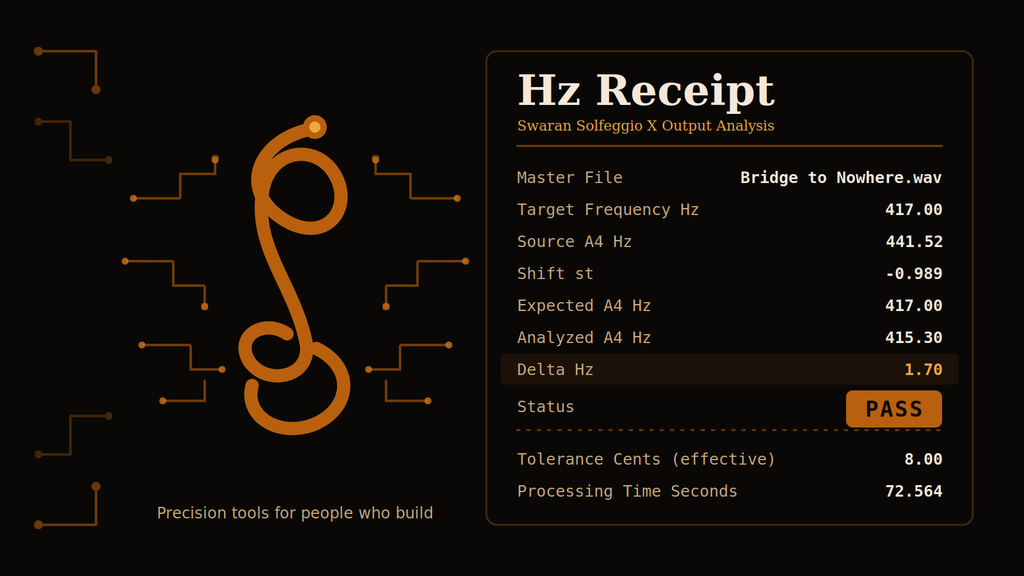
Every single conversion writes its own plain-text proof. What you asked for. What Swaran Solfeggio X actually measured. The exact margin between them. A clear pass or fail. Not a marketing claim about accuracy. A number, sitting in a file next to your audio, that you can open and check yourself.
Nothing about this is hidden behind a percentage on a website. It travels with the file.
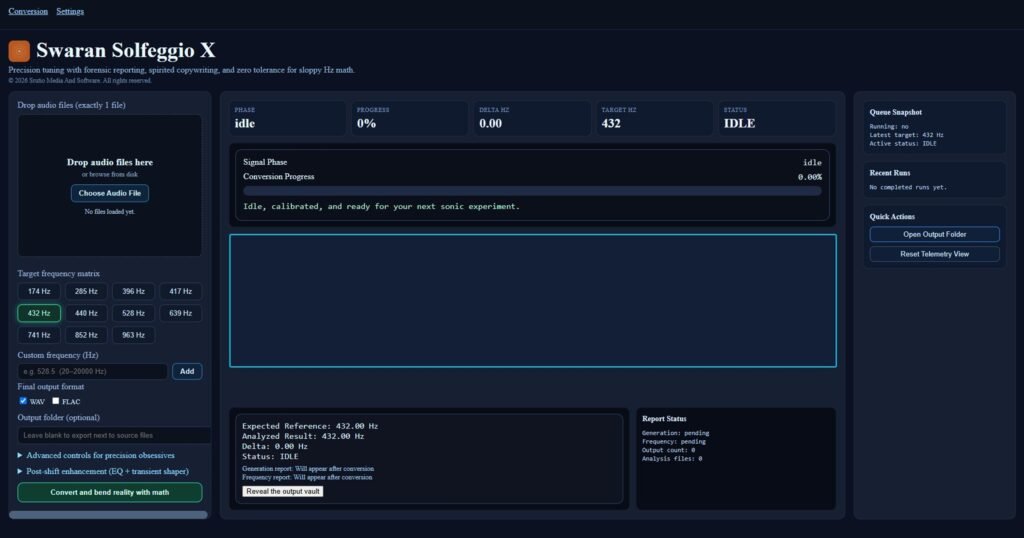
The Control Room
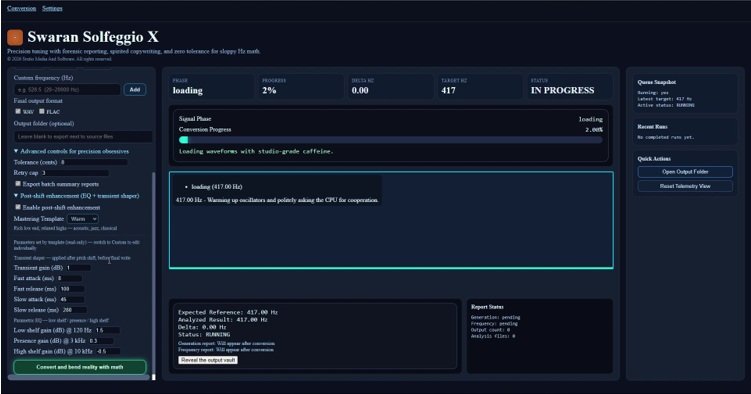
You do not wait on a loading bar and hope. The Control Room shows exactly what is happening, phase by phase, in real language, the entire time a conversion runs. Once it is finished, play the result back without ever leaving the app.
Named for where an engineer actually sits: the glass, the monitors, a clear, unobstructed view of the work as it happens.
Shape the Sound
Correct Pitch Is the Floor, Not the Ceiling
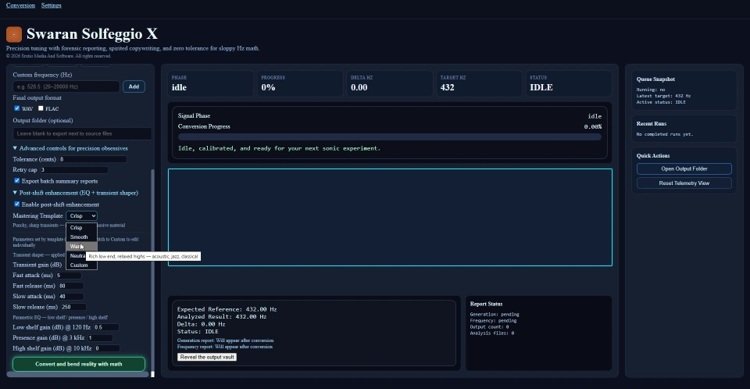
Getting the frequency right is the minimum. Swaran Solfeggio X also masters the result, and lets you hear the difference between four real sonic characters before you ever commit to one: Crisp for rock, metal, and anything percussive. Smooth for ambient, drone, and sleep material. Warm for acoustic, jazz, and classical. Neutral, when the only job is a clean, honest cleanup with nothing added.
Or skip the presets entirely and take direct control of every EQ band and every transient parameter yourself.
None of it can touch what Śruti Lock already proved. The correction is measured and locked before a single decibel of mastering is applied, never after, so shaping the sound can never quietly shift the numbers on your Hz Receipt.
The Result
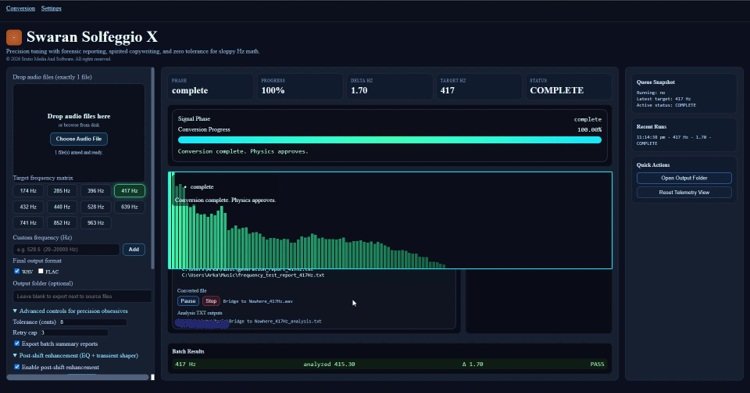
This is what finishing actually looks like: a real measured result, a real margin, a real pass, sitting next to the file it belongs to.
Built to Be Trusted, Not Just Believed
Code-signed under an Extended Validation certificate, the same standard banks and major software vendors use. Windows shows a verified publisher, not a warning.
Everything happens on your own machine. Nothing about your audio is ever uploaded anywhere to get converted.
Built and used daily by a working audio engineer on real sessions, not assembled as a side project and shipped untested.
Current version 1.0.6. Windows 10 and Windows 11, 64-bit.
Pricing
₹5,999 + 18% GST (As Applicable)
Once. No subscription. Covers two devices.
Frequently Asked Questions
Is this just another 432Hz converter?
Plenty of those exist. None of them measure their own result and prove it to you afterward. That is the actual difference, not a marketing line.
What operating systems does it run on?
Windows 10 and Windows 11, 64-bit.
Is there a trial?
No trial. It is a digital download, and the purchase is final once your license key is issued.
What do I actually get for ₹5,999?
A one-time license covering two devices, every Solfeggio frequency plus 432Hz plus custom targets, full mastering control, and a written Hz Receipt with every conversion you ever run.